“Everyone should read Junk.” — The Times
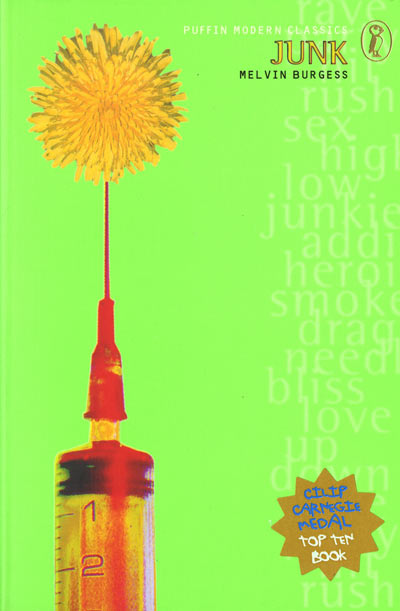
Authors Note
Junk won the Carnegie Medal and the Guardian Children’s fiction award in 1997. There were howls of protest from the right wing press – especailly the Daily Mail. It was on radio and TV, there were articles and cartoons and much breast beating about the loss of innocence in young people today and where on earth is children’s fiction going. But there was also a great deal of positive reaction. Today, Junk is still widely read, and the approach it takes in being open, honest and upfront about drugs and drug culture is seen as being enpowering thing, encouraging people to think for themselves, rather than encouraging them to take drugs, as its critics still sometimes try to make out.
It has always been my most popular book.
Junk was a real experiment for me. What is usually called teenage fiction is really for people aged up to fourteen or so. Even then, people are supposed to buy few books. But what about those from fourteen up? That’s the age group we really think of as teenagers. Of course at that age, people read adult books, but there are almost no books aimed directly at, or about, people in the middle and later years of High School and up. There are books for grandparents, babies, toddlers and grown-ups – why has this group been left alone? It’s all the more odd when you think about how big the youth market is in film, music, computer games and so on.
It was an experiment that paid off. Junk was a bestseller, here and in many other countries. Translated into 28 different languages, adapted for TV and the stage, it has been my most successful book so far.
Despite all the controversy, I have personally received only good reports about the book. I’ve had any number of letters sent to me from readers, and there has not been one bad one. So why all the fuss in the first place? Could it be that the whole thing was just a media circus? I’ve come to the conclusion that in actual fact, the numbers of people who seriously think that young people 14 and up can’t handle this sort of material are actual an odd minority holding an extreme opinion hardly shared by the rest of society. The press know a good story when they see one, but why do they have to present everything new as a controversial? In fact, in a world where drugs, drug culture and drug information is widely and available, Junk was simply very long overdue. Looking back, I’m amazed to realize that it was just about the first book to deal with the subject of drug culture for people at High School in a straightforward way.
There are so few books published that are truly for young adults. If you are aged sixteen or seventeen and you want to read fiction that talks about your life – your recreation, your sex life, your feelings and emotions – you’re either stuck with stuff about twenty-somethings, or you’re reading soft stuff that seems to be written for younger readers, or you’re reading some polite, carefully edited stuff that doesn’t dare talk about reality. Maybe that was why JUNK made such an impact.
About the book
Junk is set in Bristol, where I lived myself for eight years in the late seventies and eighties. The book falls into two halves – the first part, where the main characters, Tar and Gemma, leave home and move to Bristol, where they meet up with some squatters, and the second part, where Tar and Gemma become become addicted to heroin. The second part of the book is based loosely on people I knew at the time. I think that one of the main reasons for the book’s success is the fact that is painted very much from life. The culture of inner city Bristol, the lifestyles of many of the characters, was something I lived myself. Tar and Gemma, Lily and Rob, come across as real people because they are based on real people, and their story rings true because it is true. All the events in the second half of the book are real. They didn’t always happen to those particular characters in that particular way, but they did happen. I had nothing to invent.
Readers Comments … and some replies …
Letter from Lindsie
Dear Melvin Burgess,
Hi, My name is Lindsie and I just finished reading “Smack” yesterday. I’m sure you get emails like this all of the time, but I hope you take the time to really consider this one. I got so lost in that book, really tied to the characters, all of them. Each character was so well developed I finished the book so quickly because I couldn’t put it down. I was really torn apart by the ending, but not just because I love happy endings and wanted Gemma and Tar to be a happy family, but I was just dying to know what happen because I was just genuinely concerned. Now I know that’s just the way it goes when it comes to books, it leaves the rest to the imagination. Yet I was wondering if there was a sequel? If not, I am going to encourage that you write one. 🙂
I appreciate you taking the time to read this,
Thank You!Lindsie
Hi Lindsie,
Thanks for wtriting to me – I’m delighted you enjoyed Smack so much. You want to know what happened next? – well, as it happens that book is based upon real people (for the most part) and although their stories are are not exactly the same as the book – I changed a lot to make it a story – I can let you know what hapened next. The reason I didn’t write a sequel is because they all went off in different directions – not much ofa book there!
Gemma was rescued by her mum and dad, went back to school, got her A levels and then went to uni. She discovered that she had a good brain, got a first at uni and went on to get a good job. Tar cleaned up as well, got ajob, got re-married, had another child – but his problems caught up with him many years later and he struggled with adiction his whole life. Lily and Rob were sent to seperate re-hab clinics in different parts of the coutry and, like Gemma and Tar, when it was over they came out and found that the love had gone. This is very common with drug-dependant relationships – it’s the drug, not the love that is the basis of it all. Lily was on the game from years, but recently I hear she;s getting herself togehter – I hope so! Rob met someone else he loved and wanted to start a family. She said only if he gave up his old life and his old freinds – so he disapeared and was never heard of again, even by his kids with Lily.
Vonnie is a teacher these days. Richard died in a car accident before the book was even published.
And that’s that!
Now – a favour – can I post your email and my reply on my website? Some other people might be interested in this …
Best wishes, Melvin
Letter from Laura
I’m writting you from Lithuania. I just want to say ‘hi’. So, hi! And I also want to say that Junk is really shocking, exciting, but a wonderful book. Of course, it is difficult to read, but worth it. On the other hand, why I write this, perhaps, the most you know. By the way, Loving April was the same good book. Very emotional, close, real. Unfortunately, the blood is unable to read. It is a terribly difficult book. In addition, it’s cold. Of course my opinion and you is not as important, but in the future I would like you to read these books, about which I wrote at the top. Thank you for your attention. I am pleased that I can write such a great writer like you.
P.S. Sometimes I think that your books are suited to ‘Queen’ music, don’t you?
P. P. S. Sorry if I did spelling mistakes. My English is poor.
All the best,
Laura.
Letter from Anonymous
Hello, I’m a french girl of 23 and I read “junk” when i was eighteen. I’ve been read it again and again and I can tell you this book changed my life because after “junk” I came to a the faculty and I studied ‘psychology’ and now I’m working in a little center in Paris helping some people who are drug addict and that’s an incredible experience. I’ve find my way because of this book and i’m very grateful.
I’d like to thank you for the Buzzcocks too. I didn’t knew that band before “junk” and now it’s my way of life! That is the most exciting and amazing band I’ve ever seen and heard and since I’ve been reading this book I can’t spend a day without Buzzcocks music. (the Only Ones was a great discovery too). I was just wondering about “Lurky” and “Lurkying about”: what is this? I made so research and it’s impossible for me to find what’s that. If you can help me, and I’m sure you can, e-mail me.
I’m sorry for my english, it’s probably a desaster.. Thank you for your wonderful work, i’m so grateful, you wrote the book which changed my life.. Bye.